Friday, December 31, 2010

Solidarity From Will O’Bryan

Will O’Bryan, who is gay, wrote a great piece over the controversy surrounding the comparisons made to the David Epstein situation and same-sex relationships, expressing his solidarity with those of us who want consanguineous lovers to allowed their happiness. First, though, he expresses concerns about statements by the lawyer for David Esptein

Of course, the reasonable, conventional reflex from the gay community and its allies would be an utter repudiation of that rationale, with arguments, diagrams and psychoanalysis as to why incest and homosexuality are apples and oranges.

They are different categories of sexuality. There are some consanguineous same-sex couples, for example. But both categories fall under “consenting adults.”

He also see’s Saletan’s point

The portion of Saletan's argument that boils down to the gay taboo of same-sex lovin' being the only avenue available for gay people, while someone with an incestuous attraction could simply look elsewhere, has some merit.

What gives anyone the right to tell consenting adults they have to look elsewhere instead of to each other?

Thankfully, he goes on to express a high level of solidarity.

In the ways that we've strained to outdo our oppressors, which seems a common reaction among the oppressed, aiming to prove we can surpass whatever hurdles our oppressors place before us, we perhaps emulate them in ways that make me as uncomfortable as a God-fearing, GOProud, married gay parent with four children and a golden lab when the leather/BDSM float passes at the pride parade.

Those who have been told to stand at the back of the bus should not be so quick to throw others under it. Instead, we should all join together and insist that we all should have equal access to sit in the bus.

I will grant that incest and homosexuality are not the same things, particularly when it comes to a parent and child. But I may also feel uncomfortable when I see an employer bedding an employee or a teacher fooling around with a pupil. But I'm not going to feel threatened if someone equates the two for the sake of legal argument. Why should I feel uncomfortable?

Thank you.

The human norm evolved so that we have two sexes, each sexually attracted to the opposite, leading to reproduction. That norm has often been enshrined into law. But I don't want to submit to such laws because I am gay. If I was one of those kinky Bel Ami ''twincest'' twins, Milo and Elijah Peters, considering my brother my boyfriend, I might also resent the laws against incest. I can promise, however, my straight brother and I will never be getting it on. That does not, however, put me in any position to support a law telling Milo and Elijah they can't do their (highly lucrative) thing.

Thanks again.

So I just can't get that worked up about two grown people having an incestuous relationship. Even in the case of the Epsteins where a line has been crossed between parent and child and there may be psychological fallout for years to come for the latter, she was an adult when this began.

Don’t we all know people, perhaps ourselves, who have been emotionally scarred from nonconsanguineous relationships with people roughly the same age? Infatuation or love always brings such potential. Relationships can end up hurting, but they can also bring much happiness. Either way, as long as the participants consented, the law should not be against it. O’Bryan eloquently gives one reason why…

And for those who do care, who demand laws to prevent this sort of thing, who are you kidding? I don't really know how such laws might affect the incestuous, but I can tell you that attempts to ban homosexuality did little more than ruin lives – of the persecuted, of those forced into unhappy marriages, and sometimes the children of those marriages. They did not help society. And with or without such laws, the number of gay people remains the same.

Yes. It seems that the greatest harms caused by these relationships are, ironically, caused by the fact that others try to interfere in them with laws, violence, harassment, and insults.

I've been told my sexual expression is disgusting, though that was far truer 20 or 30 years ago. Now that I can get married and join the Army, I could wrap myself in propriety and call others disgusting. Because of my experience, having to consider and dissect and wear my sexuality for decades, rather than simply take it for granted, I cannot. Instead, I grant that if two – or 10 – adults consent to sexual activity, it's really none of my business. If the thought of it makes me feel foul, I will think about something else.

Brilliant. Amazingly brilliant. Thank you, Will O’Bryan.

Polygyny in Israel

There's a battle in Israel over polygyny in some of the Muslim population. There are groups actively trying to end the practice.

Since polygamous marriages aren't recognized by the government, no official statistics exist. But the Research and Information Center of Israel's Knesset, or parliament, estimates that somewhere between 20 percent and 36 percent of bedouin households in the southern Negev region, where most of bedouin live, are polygamous.

Whatever the percentage, it is clearly not a rare practice.

Primarily a media campaign using posters with women's testimonials, the "No Excuse for Polygamy" initiative also holds meetings and seminars aimed at educating single women about the price of polygamy.

I have no problem with someone explaining to anyone else willing to listen why they would not want to participate in a polygynous marriage. But adults should be able to freely choose their own marriages, and that includes a woman choosing to be one of two, three, or four wives to one husband.

With an annual growth rate of 5.5 percent, Israeli bedouins are one of the fastest growing populations in the world.

Many polygamous populations are growing faster than the general population. That is going to mean more popular support for the right to polygamous marriage.

"Women are the greatest beneficiaries of polygamy," Abu-Da'abes told the Israeli-Arab weekly Kul Al-Arab.

Abu-Da'abes, while a supporter of the right to polygynous marriage, is no supporter of full marriage equality…

For that reason, Abu-Da'abes criticized Arab men who take foreign women in addition to their Arab wives, saying he would like to issue an Islamic legal opinion, known as a fatwa, against mixed marriages.

Any adult should be allowed to marry any other consenting adult(s).

Yazbak dismissed Abu-Da'abes' argument, saying polygamy causes poverty and dissolves the family structure.

I would like to see a comparison of divorce rates and other indcators of “dissolving the family structure” between this bedouin population and the professing monogamists in that country. I suspect the bedouins have a stronger family dynamic.

Again, I would like to point out that I support full marriage equality, and as part of that, gender equality. Both men and women have to be truly free to make their own choices about getting married and, if need be, getting divorced. I support the right to polyandry as much as I support th right to polygyny.

Thursday, December 30, 2010

Nonmonogamy on Yahoo Answers

There were a couple of discussions I noticed on Yahoo Answers relating to nonmonogamy.

Celes asked

If I wanted to have a polygamous marriage, should I have it with bisexual men?

Depends on how much fun she wants it to be! Seriously, if a woman wants a polyandrous situation, she has to ask herself if she’d prefer that sexual encounters or bed-sharing would be stricltly one-on-one or at least sometimes as a “threesome.” Would the want the social structure of the relationship to be a triangle or a “V,” assuming she would only need two husbands.

Since I KNOW there isn't a straight man on earth who would be comfortable sharing a bed with me and several other men let alone sharing just little old ME.

Actually, there are men who identify as straight who would be comfortable. I don’t think a majority of straight men would, but there are some.

Bisexual guys seems like the best option, doesn't it?

That is up to personal needs.

The husband I have now (and forever, despite what some of you might think, I really do LOVE him) is interested in 'experimenting' but is too afraid to go through with it.

She updated her question to indicate that her husband is most definitely straight, in response to someone asking her why she married a gay man.

Her own words: interested in 'experimenting'. That isn’t quite a desire for polyandry, although it could lead to that. It soulds like her husband is interested in at least seeing another man or other men with his wife. That could be done in any number of contexts, ranging from picking up someone in a bar to an ongoing polyamorous relationship.

BTW, for ya'll who find it so 'disgusting'....good news! I never asked any of you join in on the party, so nyyyyahh!!! :P

She told them! There were a few allies.

Tam Writer…

Um... sure, why not?? I mean, that way, you can all enjoy each other.... :S.... XD

Creation Crusher 5000…

Do whatever you want. It neither picks my pocket, nor breaks my leg.

*ajidamoon* the Eh team…

In my polyandrous marriage, I do not plan on having group sex, but rather a different man for every night of the week. Its not fair that women peak near twenty years after males.....so I feel I need several men for compensation and to be able to keep up with me. Thus negating the need to only marry bi-sexual males. Of course, I might throw a few more wives in for variety as well.

Come on up to Canada....polygamy/polyandry will be legal by 11's end.

May it be so!

DAVID…

All I have to say on this subject is thank God for penicillin, to be fair to this weired Polyandryist he has not included farm animals in his experiment (give it time now I have planted the seed, in a manner of speaking).

Is David unaware that if a group of people who have no communicable disease have sex, none of them will get a communicable disease as a result?

laduni…

Why don't you just be a prostitute. You get paid that way.

What kind of an answer is that? A bigoted one.

C V…

It is possible for polygamous marriages to be strong and successful, but I don't think we have the right mentality for it in modern society.

I don’t think we’ve ever been closer to having the right mentality. Much of that is because of gender equality.

Scarlet MacBlu…

While some bisexuals can be polyamorous (just as some straight or homosexual people) not all bisexuals are interested in sharing or being shared. The assumption you also seem to be making here is that your lovers/husbands would be actually interested in each other... there is no gurentee of that.

This is all true. That is why everyone needs to be on the same page.

And now for one of the answers that received low ratings, thankfully. That gives me hope.

Pontiff…

sorry but that's disgusting

I’m sure there are things Pontiff does that some people find disgusting. For example, I find bigotry disgusting.

Experiencing something like this is one thing but to actually want to live such a life means you have no morales whatsoever.

How would Pontiff know if she has no Morales? She may be thinking of including Morales as the secondary.

On to the second question.

Gum drop…

Are you for or against polygamy?

Sherif Fahmy…

Against. It is inherently misogynist.

I assume that person is thinking only of polygyny, but I think the person is confusing some of the other practices of some societies with the freedom to polygyny. With gender equality and the freedom to divorce, polygyny is entirely voluntary for all involved.

Carl L…

Neither as long as all involved consent to such a relationship, but personally I wouldn't be interested in it.

Thanks, ally! So many of the other answers were typical anti-equality bigotry and myths.

The Legal Nitty Gritty of Polygamy

A very helpful person commenting on a previous entry provided and essay on two different possible models for legalizing polygamous or polyamorous marriages. I have previously expressed support for what the essay calls an “all-with-all” model, in which everyone in the marriage is legally considered a spouse of anyone else in the marriage. As such, if two married people wanted to add a third person, it would legally re-form the marriage instead of adding a second marriage to one of the current spouses. Practically, while a Muslim man who practices polygyny would consider up to four women his wives, those wives may or may not (more likely, wouldn’t) consider any of the other wives their spouse. While the man would have four spouses, each of his spouses would only have one; him. Legally, however, “all-with-all” would consider them all spouses of each other.

The essay below favors another model, a “dyadic network” model, in which our hypothetical polygynous man may see two of his multiple wives also marry each other, and later divorce each other while both staying married to him. This does have a certain appeal, because if all three spouses are able to consent to go from a “triangle” to a “V” socially and financially in a peaceful, then isn’t that a good thing that should be supported legally?

My concern, though, is this. Existing marriage laws, at least in the US, create what amounts to a corporation with the two spouses having an equal financial share unless otherwise specified. The default is that should one of the spouses die, the other spouse retains the corporation’s assets. This would have to be changed under the “dyadic network” model, otherwise we’d have what amounts to multiple corporations with equal claims to the very same assets. To use a business model, if a corporation owns a plot of land, how can one of the shareholders create another corporation that has then has ownership of the same plot of land at the same time? The original partner shareholder is not likely to be happy with that. With the “all-with-all” model, shareholders are added to the existing corporation. Given our current laws and legal system, I would think the “all-with-all” model would be easier to legalize.

I am not a lawyer. If a court or legislative body was considering increasing the freedom to marry by adopting the “dyadic network” model, I would support that. My chief concern with this blog is full marriage equality, which includes, among other things, the freedom to polygamous marriage. That may involve a man and multiple women (polygyny), a woman and multiple men (polyandry), or the grouping of multiple men and women. Consent of all involved is essential. This consent not only includes the freedom to marry, but the freedom to divorce.

Under the “all-with-all” model, if one or more spouses wants to bring an additional person into the marriage and one or more of the other current participants is resistant, the person(s) seeking to change the marriage can either 1) give up on the idea, 2) convince those resistant so that they will sign the paperwork, or 3) accept that to add the new person(s), someone else is going to leave. The resistant can either decide to leave or decide that the change will be worth it to stay in the marriage that includes the current spouse(s). The paperwork burden is on those who want to bring in new spouses.

If one or more spouses want to leave, the remaining spouses can decide to stay together in the instantly re-formed marriage, or not, but they can’t stop anyone from leaving.

Under the “dyadic network” model, if one or more spouses want to bring an additional person into the marriage and one or more of the other current participants are resistant, the paperwork burden is on those who want to leave. They must take action, while in the “all-with-all” model, all the resistant have to do is say “no” when someone else wants to add someone else, and it will be up to the person seeking change to either drop the proposed change or leave the existing marriage to create a new one.

The essay describing the dyadic network model is below. More information can be found here.

Proposed models of polyamorous marriage include an all-with-all approach to marriage (whereby three or more persons are all joined together at the same time within a single marriage) and dyadic networks (whereby existing laws against bigamy are revised such that people are perfectly free to be concurrently married to multiple other persons, provided that each such new marriage is preceded by a legal notification regarding the pending new marriage to all those to whom one is already married; failure to provide that legal notification would then constitute the updated crime of bigamy).

Anthropologists consider humans to be a pair-bonding species.

This does not make it necessary for our marriage laws to be based on pair-bonding. What (some, majority, “all?”) anthropologists believe need not translate into law. Social dynamics don’t necessarily need to be the basis of the law. Marriage laws are mostly about property, taxes, and other financial considerations, next-of-kin rights, and recognition. This is something to keep in mind as we look at the rest of the essay.

The “all-with-all” approach attempts to replace human pair-bonding with triad-bonding, quad-bonding, etc. Dyadic network theory says that human pair-bonding is our fundamental method of relating, and that polyamorous relationships arise from overlapping pair-bonds.

Dyadic networks would result in what might be thought of as a "molecular" family structure - one which might be best represented by the molecular diagrams commonly used in chemistry. In this way, marriage would remain a dyadic relationship (i.e., a relationship between two persons), thus minimizing any changes to the existing system of legal marriage, but the introduction of concurrency would provide access to legal marriage for polyamorous families.

Dyadic networks can correctly represent any situation associated with the "all-with-all" paradigm, as well as many situations that the "all-with-all" paradigm cannot deal with. A "complete" dyadic network would take the form of a complete graph, in which every person is (pairwise) married to every other person, thus correctly representing any situation associated with the "all-with-all" paradigm. A dyadic network may also represent situations in which some persons are (pairwise) married to some members of the dyadic network but not to all of them ("V" and "N" geometries, for example) — these are situations that the "all-with-all" marriage paradigm is unable to accurately represent.

Under the current restrictive “monogamy only” laws, two people can be considered married under the law even if they haven’t done anything with each other in years except share an address. They could be having sex with others and carrying on almost entirely separate lives. In that sense, the situation is not “accurately represented” by the law. There is no reason that legal recognition of polyamory (or the polygamous freedom to marry) would have to correspond to the social dynamics of the relationship. In other words, not all of the spouses need to actually be lovers with each of the other spouses.

The "all-with-all" marriage paradigm assumes that everyone is equally involved with everyone else in the group — one global marriage agreement has to fit every participant at the same time. But dyadic network marriages separately define the terms of each specific 2-person relationship, and these dyadic marriages do not typically happen at the same time (A marries B, B marries C ("V" structure), C marries D ("N" structure), etc. — thus, the shape of the dyadic network dynamically changes over time). Participants in a dyadic network need not even be aware of the specific terms of marriage agreements existing elsewhere within the same dyadic network.

Someone with the ability to refuse consent should be aware. That means either the registering government or the other spouse(s). Why? Let’s say person A marries person B with the agreement that B will be the income earner while person A will maintain the home. The agreement is that should they divorce, person A is entitled to 50% of the material acquisitions ("community property") during the marriage. Now, let’s say B subsequently marries C, with the same agreement between B and C. If either connection ends in divorce, the agreements will be discovered to be in conflict. That is why all spouses should have to consent and be aware and file a valid marital agreement (such as with an “all-with-all”). For example, A, B, and C would all have to agree that that anyone leaving would be entitled to 33% of the community property, or if they all agree that B should get 40% and A would get 30% and C would get the remaining 30%, then that is fine if they’ve all agreed to that. A and C wouldn’t have to be having sex with each other or even share meals for them to be part of the same marriage.

Under the "all-with-all" marriage paradigm, when irreconcilable differences arise there can be no alternative to a complete separation — one person cannot divorce another without ending the entire marriage agreement for everyone involved.

It would mean that those who want to remain married would instantly have a re-formed marriage. Instead of three people, it would be two people, with the person who left taking whatever their marital agreement provided or what the default divorce laws provide. It would be up to the person who has irreconcilable differences with one or more of the other spouses to decide if those differences matter enough to either want to leave the marriage alone, or convince the spouse or spouses with whom he or she would still like to be with to “leave” with him or her.

But dyadic networks can function in much the same way as watertight compartmentalization functions in naval vessels, i.e., to limit and contain damage. An intense disagreement between two persons takes place within the context of their marriage, and need not greatly involve (or threaten) the relationships between other participants. Within a well-connected dyadic network, a divorce between two persons need not result in a complete separation of the network — for example, a dyadic network with triangle geometry would simply turn into a dyadic network with "V" geometry.

An "all-with-all" marriage can only exist or cease to exist. In contrast, the shape of a dyadic network can dynamically change over time. Divorces subtract connections, and marriages add connections. The dyadic network itself either changes shape, separates into two dyadic networks, or merges into another dyadic network, depending on the precise nature of the newly added or subtracted connection.

The maximum size of an "all-with-all" marriage is limited by the fact that every participant must be aware of the existence of every other participant (otherwise the global marriage contract would be invalid, because it could not satisfy the legal condition known as a "meeting of the minds"). But since a dyadic network relies only upon every participant's local knowledge of his or her own direct partners, its size is theoretically unlimited. The dyadic network paradigm is so powerful that it is theoretically capable of managing a situation in which every adult on earth is legally joined together in a single enormous dyadic network. Thus, with the dyadic network model, the idea of "many loves" is directly translated into a practical reality, and the "infinity" symbol (representing love without limits) is directly matched by a marriage model capable of handling an infinitely large number of participants.

The Dyadic Networks model of polyamorous marriage raises important questions related to marital commitment. With a single dyad, the situation is simple; each spouse commits to support and protect the other, and the logic of conventional monogamous marriage applies. However, when multiple dyads intersect in a dyadic network, how exactly does the commitment process work?

To understand this, let us consider the parent-child relationship. In the parent-child situation, the support commitment exists only in one direction - from parent to child. When there is a single parent, the child has a single source of commitment, and all protection must come from that source. However, when there are two parents, they are jointly responsible for meeting the child's needs. The precise arrangement is worked out somehow, and provided that the child's needs are being met the law has no need to intervene. If the child's needs are not being met, then debt collection methods such as garnishing wages, seizing assets, etc. can and do occur in order to ensure that child support takes place. These actions are typically proportional to income and/or wealth, so the wealthier parent will pay more. Where a parent has commitments to multiple children, the parent must faithfully carry out his or her responsibilities to each and every child. Although it may sometimes seem that the needs of children are unlimited, this is not actually the case, and once a child's needs are satisfied (a certain amount of food, shelter, medical care, etc.), all parents of that child may regard their commitments as being satisfied with respect to each need for which adequate provision has been made, regardless of which parent(s) actually did the work of satisfying that need.

Turning now to commitment in the dyadic network model, this can be understood as a bidirectional version of the parent-child model. Each dyad represents a commitment of each spouse to the other. Thus, in a V configuration, the two partners at the ends of the V each rely upon commitments from the single partner at the center of the V (the "pivot") - each of them has one spouse. The "pivot" partner can rely upon two commitments, one from each of the two partners at the two ends of the V - the pivot partner has two spouses. If the pivot partner is incapacitated, he or she is in a position comparable to that of a child with two parents - two people are committed to assist him or her and must do so up to the point at which the pivot partner's needs are satisfied. If one of the partners at the end of the V is incapacitated, he or she has only one spouse to rely upon - the pivot partner, who is fully responsible for meeting the incapacitated partner's needs up to the point at which that partner's needs are satisfied. If both partners at the end of the V are incapacitated, then the pivot partner is in a position comparable to that of a single parent with two sick children - he or she must meet the needs of both.

Again, this is why consent is required by all. If A and B are married, and B wants to marry C as well, A must consent. Maybe C is engaged in risky behaviors that make it more likely that C will become incapacitated, and A, who has been counting on full access to the financial and emotional resources of B, must now consider if this new risk is acceptable.

Let us now consider whether the commitment relationship is "transitive" - if A is committed to B, and B is committed to C, does this mean that A is committed to C? No, this is not the case. C can legally rely only upon the commitment of B and has no legal basis to expect or receive a commitment from A. Nor can A rely upon the commitment of C - that could happen only when and if A directly married (mutually committed to) C. However, suppose that C's needs are so large that B is thereby driven into bankruptcy and becomes destitute. Then B can rely upon A's commitment to provide B with a certain minimal level of support (food, shelter, medical care, etc.). Thus C's needs can have an effect on B that causes A to provide more support to B than would have been the case had C not needed to draw heavily upon B's commitment.

Hence, under the dyadic networks model, positive effects arise as a result of multiple commitments. When there is only a single dyad, there is a substantial risk that the size of the commitment will exceed the capacity of the committed. However, when each person is linked to multiple other partners in a dyadic network, this has the effect of bringing in additional capacity to meet any needs that may arise. Three or four spouses may be easily able to carry a commitment load that would have quickly driven a single spouse into bankruptcy.

The analogy to parent-child relationships carries over into other situations as well. Just as it would be improper to discriminate against a parent for having too many children (or too few children), so it would be improper to discriminate against a person for having too many or too few spouses. But with each additional child comes an additional commitment, and the same is true of an additional spouse. Adding another child to one's health insurance coverage will usually result in an increased monthly charge for the insurance, thus adding another spouse would probably have a comparable effect. But a child, or a spouse, only needs to be covered once, regardless of how many parents, or spouses, are available to provide that coverage. Also, a spouse may be economically self-supporting and thus able to pay for his or her own health insurance, so in this respect the total support cost for an additional spouse would then be zero.

Having drawn lessons from the parent-child relationship and applied them to dyadic networks, let us now draw a lesson from dyadic networks and apply it to the parent-child relationship. Just as there is no inherent reason why a person should not have more than one spouse, so there is no inherent reason why a child should not have more than two parents. When the law of marriage is updated to legally support dyadic networks, the existing adoption mechanism can be used as a means by which additional commitments to children can be created. For example, a single dyad may have already produced two children when each member of the dyad marries a third partner, thus creating a triangle. The newest member of this dyadic network can then execute two adoptions to become the third parent of each of the dyad's two children. Hence, in this situation, each of the three adults now has two spouses and two children. To the extent that any legal barriers might hinder the use of adoption in this manner, such legal barriers would also need to be direct targets of polyamory's legal activism (in addition, of course, to updating the law of marriage to support dyadic networks).

This N-parent situation has already been raised in the New York Times (When 3 Really Is A Crowd, July 16 2007, http://www.nytimes.com/2007/07/16/opinion/16marquardt.html): “On April 30, a state Superior Court panel ruled that a child can have three legal parents. […] Arthur S. Leonard, a professor at New York Law School, observed, 'I’m unaware of any other state appellate court that has found that a child has, simultaneously, three adults who are financially obligated to the child’s support and are also entitled to visitation.' […] As one advocate of polygamy argued in Newsweek, 'If Heather can have two mommies, she should also be able to have two mommies and a daddy.' If more children are granted three legal parents, what is our rationale for denying these families the rights and protections of marriage?” Our firm answer: there cannot be any legitimate rationale for the unconstitutional denial of this legal protection to polyamorous families.

The New York Times op-ed raises a question: “Conflicts will undoubtedly arise when three parents confront the sticky, conflict-ridden reality of child-raising, often leading to a nasty, three-way custody battle. Even if they part amicably, they may still want to live in three different homes. In that case, how many homes should children travel between to satisfy the parenting needs of many adults?” The legal answer has been provided by New York Law School Professor Arthur S. Leonard (Pennsylvania Court Finds Three Adults Can Have Parental Rights, May 01, 2007, http://newyorklawschool.typepad.com/leonardlink/2007/05/pennsylvania_co.html): “[...] the court gave Jennifer primary custody of the one nephew who was living with her, and partial custody (visitation rights) with the other three children; Jodilynn got primary custody of the three children and partial custody (visitation) with the one nephew, and Carl was awarded partial custody (visitation) of one weekend a month with his two children.” In the event of divorce, family law judges will calculate child support obligations and distribute visitation rights in accordance with the best interests of the child(ren).

Again, I would support the Dyadic Networks model as opposed to no gain in the freedom to marry, but I'm not yet convinced it is better than the all-with-all model. With either model, I would strongly recommend there be a written agreements over what would happen if any one of the participants decides to leave.

Tuesday, December 28, 2010

Polyamory Allies on Yahoo Answers

The question was “Do you support polyamorous marriage?” The person asking does. So do many of the people answering.

No Magpie Without Chance…

As long as everyone involved is a consenting adult and my taxes are not subsidizing it, it's none of my business.

Utsuho…

I honestly could care less about it. If people wanna get freaky that way, sure why not.

auntb93…

I personally feel that marriage is OK for anyone who takes it seriously.

Eye Of Night…

I couldn't care less, really.
If people manage to earn the right to marry multiple partners, well, more power to them, but I'm busy enough minding my own business to fight to the benefit of others.

Marisa Kirisame…

I personally don't like it. But various religions like Christianity support it, so why not? Go ahead if it floats your boat.

Jryanwinterhaven…

The US is a little behind on this issue. Gay marriage is already legal in Canada an the issue of multi-partner marriage (polyamory - with its various forms [polygamy, polyandry, etc.] is headed for Canada's highest court for a decision. Monogamous marriages is a cultural minority world wide. So... Yes, and I think there is plenty of evidence that it can work, but no better or worse than monogamous marriages.

It is always nice to see diverse support for this freedom to marry. You don’t have to want a polyamorous relationship yourself to support the rights of others.

Clearcutting in the Rainforest

Amazon.com has decided that, at least in some cases, fictional stories with consensual adult sex had to be pulled from their vitual shelves.

Self-published author Selena Kitt was first notified that the print version of one of her fiction books violated Amazon's content guidelines last week, followed by the unceremonious removal of two more offerings from the Kindle store. After noticing that the three books that Amazon singled out were all "erotic incest fantasy fiction," she found at least three other authors whose incest-themed erotica had been removed from Amazon, followed by a Kindle support thread full of even more names.

Kitt compares incest to murder, pointing out that she doesn’t “condone or support actual incest, just as someone who writes mysteries about serial killers wouldn't condone killing.” I understand Kitt’s point, but the comparison is a bit lacking. Those who want to justify banning the sale of such fiction will note that most mystery writers write in such a way as to condemn lawbreakers and depict murder as a horrible thing, while Kitt’s works appear to be written to as to assist sexual arousal by depicting illegal sex in a positive or neutral tone for those interested in that kind of (in many places) illegal sex. Those like me, who support the rights of all adults to love, sex, and marriage, do not appreciate the comparison of loving or playful sex between adults to murder. I can hardly blame Kitt, though. She was put in a difficult position that threatens her income and coming up with the best comparison was probably not a top priority. She shoud not have been put into that position in the first place.

I support Amazon.com and other sellers in taking actions to protect the innocent, such as children, from harm. But I urge them not to pull material about consensual adult sex from their shelves, virtual or otherwise.

A Basic Freedom

William Saletan had more to say over at Slate.com. This was prompted by the beautiful death of “Don’t Ask, Don’t Tell.”

The distinction between marriage and partnership isn't the only institution being challenged. Technically, the Uniform Code of Military Justice and the Manual for Courts-Martial prohibit sodomy, bigamy, adultery, "wrongful" cohabitation, and incest.

I fail to see why a government employer such as the military should be able to tell an employee how to conduct their love lives. Rape, assault, molestation of minors should all remain illegal. But it should not the the employer’s concern if a soldier loves more than one other consenting adult, or if those adults are male, female, or have a close relation to the soldier. There shouldn’t be laws against such relationships inside or outside of the military.

Sodomy and adultery laws do seem outdated and silly. But if those laws are repealed on the grounds that consensual sex is private, it's hard to explain why the reform shouldn't extend to other laws.

It is hard to explain because those who try to explain it contradict themselves or invoke bigotry, but try not to admit it.

After quoting me, he goes on to write…

Laugh or snort if you want to, but it's a serious question. If DADT repealers are correct that sex is a matter of personal liberty and it doesn't matter "who you love," why shouldn't that defense cover polyamory and sibling couples?

There isn’t a good reason, so it should cover them.

You can argue that homosexuality is quite different. But to make that case, you have to go beyond privacy and consent. You have to draw moral distinctions.

Homosexuality isn't just a matter of who you love. It's a matter of who you are. And it's compatible with traditional sexual values.

First of all, why should an employer care whether or not something is compatible with “tradional sexual values?” Secondly, there is a long, ongoing tradition of polyamory, polygamy, and consensual consanguineous relationships.

You don't choose to be gay. You just are gay.

At least some people who are polyamorous (some of whom are lesbian, gay, or bisexual, by the way) didn’t choose to be polyamorous either. Polyamory is as natural to them as being straight or being gay. Some people in consanguineous relationships (again, they may be lesbian, gay, or straight) swear on their life (literally, given what they have to go through) that nothing else compares. While these two categories are not currently recognized mainstream as categories of sexual orientation, they are as much of what makes these people and their relationships who and what they are as gender.

A gay person can be just as faithful and monogamous as a straight person.

Why is monogamy important? It is assumed by the writer that it is, without an explanation being given. Right now, a soldier can have a series of ten short sexual relationships. Why is that any better than the solider having three wives and only having sex with those three wives?

If the fall of DADT is ultimately interpreted this way - as a rethinking of homosexuality, not of sexual morals generally - it won't satisfy libertines or libertarians. But culturally, it might prove easier to digest.

I give the culture more credit than that. More people are open to equality than a lot of people think. Let our soldiers, and the rest of the people, make their own decisions about who they will love, and don’t make them second-class citizens because of it.

Of course “straight, gay, lesbian, and bisexual” is a different set of categories from “celibate, monogamous, polyamorous, etc.” and “exogamous, endogamous, and consanguineous.” but the military shouldn’t be concerned about any of those categories. Someone can be gay, celibate, and have endogamous attractions. Or, someone can be straight, polyamorous, and exogamous. What matters is how they do their job. Freely choosing the person or person(s) they love should be their basic freedom.

Monday, December 27, 2010

What About the Children?

Abdullah asked a very common question…

How likely is it that brother-sister incest will produce a healthy child?

Taking the question exactly as it is written, a very small percentage of sexual encounters result in a live birth. Only sexual encounters that result in a healthy sperm entering a healthy egg and fertilizing it, followed by successful implantation in the uterus, followed by gestation until viability will produce a healthy child. (This is leaving aside reproductive technologies, donors, and surrugotes.)

But I suspect that the question the person was really asking is that if a brother and sister have a pregnancy that comes to term and is successfully delivered, what are the chances of the child being healthy?

Most likely, with any given brother and sister, the child will be healthy. With any birth, there is a chance of the child having a birth defect or genetic problem. All it takes is for a genetic problem of one or both parents being passed along, or a the embryo developing one on her own. If two people have the same genetic problem, as siblings may, there is an increase in the chance that their child will have the same problem in comparison to the general population. However, that increase in chance will still mean that the overall chance is a minority chance.

Anyone concerned about these things should have genetic testing and counseling. People who are not close relatives can pass along health problems.

We do not deny people the freedom to marry based on their lack of ability to birth healthy children or lack of intention to birth children. We do not make criminals out of them based on those things, either.

Some People Actually Enjoy Sex

In his blog entry and subsequent comments, C.J. appears to claim that legal adults aren’t really adults until age 30, so they can’t possibly consent to sex with a parent before then. What’s more is that sex is a bad thing most of the time, apparently.

Epstein's daughter no more "consented" to her father's attentions than a child "consents" to his soccer coach's attentions. One of the most difficult aspects of post-molestation therapy is helping the survivor overcome his or her guilt. Children--and make no mistake, teenagers are still children--are relatively easy to coerce.

We hold adults responsible for their actions, whether they are 18, 21, or 35.

Likewise, incest is a crime perpetrated on the individual, that damages the individual.

I wonder if people who use these arguments can only enjoy sex if they are the same age or older than their sex partner? Their arguments seem to be based on an assumption that the adult child is getting no enjoyment or benefit out of the relationship, or that if they think they are, that adult child must have some form of reduced capacity.

Carla asked in the comments…

What is your opinion of sibling incest then? I wasn't necessarily thinking of the legality; I was curious about your personal moral opinion of it. You mention that there's a problem with it - what is that?

C. J. replied…

My personal moral problem with it is that it represents a betrayal of trust.

Again, I get the impression that these people think sex is generally abusive and about betraying other people.

First, the confusion of roles and relationships involved is highly damaging to both parties.

Some siblings disagree with you. They have found that becoming lovers has made their lives better. They don’t have a confusion of roles, they have additional roles.

How, after engaging in an incestuous relationship with a sibling, is this person supposed to move forward and have a normal life?

The same way someone has a normal life after the end of any sexual relationship.

In the cases I've read, post-incest survivors reported having an extremely difficult time forming attachments to other people, and an almost impossible time enjoying sex.

There are people who claim that any sex someone had with someone they are no longer having sex with hinders that person’s ability to form attachments and enjoy sex. It is one of the main reasons given by monogamy proponents who say that nobody should have sex outside of a monogamous marriage. Shall we make all sex outside of marriage illegal? Outlaw remarriage?

But there are people who say that after having a sexual relationship with their sibling, nothing else can compare. So it would have been better that they never had that great experience? That’s a rather lousy way to live life, if you say people shouldn’t do things unless they can be assured that they will always be able to have things that good.

Moreover, I feel like, in a family structure where there are no taboos, how do you teach that abuse is wrong?

Who said there were no taboos? Here’s what we should teach other other: Don’t do things against another person’s will, like hitting them or touching them.

How do you even define abuse?

It really isn’t that hard. An adult having sex with, raping, or fondling a minor is abuse. A much older minor having sex with, raping, or fondling a minor is abuse. Beating someone else is generally abuse. Like that.

It seems to me that the potential for domestic violence is much greater.

Huh? Why, do you beat your lover, or would you beat your family member if you were having sex with them?

Also, once the relationship starts, how does it end?

The same way any other relationship ends. Or it doesn’t end. There are family members who go into business together, and a lot of new businesses fail. A lot of sexual relationships end. Should it be illegal for family members to go into business together?

Then, of course, the question is, what happened in these kids' early lives to cause them to be attracted to each other?

People used to ask that about LGBT people, too. That you don’t understand why someone is attracted to someone else does not mean that anyone else has a problem.

Really, we get it. You’re not attracted to anyone in your family. Or if you are, you don’t want us to know it, and you think it would be a bad idea to act on it. Fine. You don’t have to.

Sunday, December 26, 2010

More Polyamory Can Make the World Better

PsychologyToday.com continues to feature adapted content from Polyamory in the 21st Century by Deborah Anapol, Ph.D. In this entry, we find “The Upside of Polyamory.”

Polyamorous relationships offer many means of accelerating personal growth. All intimate relationships at their best are a path to higher consciousness and greater self-knowledge, largely because of the valuable feedback-or mirroring effect-one receives from a beloved. Having more than one partner at a time not only increases the available quantity of feedback but also makes it harder to blame your partner for the problems you might be creating in the relationship

But what about the children, if there are any?

One of the most common concerns about polyamory is that it's harmful to children, but nothing could be farther from the truth. Multiple-adult families and committed intimate networks have the potential of providing dependent children with additional nurturing adults who can meet their material, intellectual, and emotional needs. While parents may end up focusing less attention on their children, children may gain new aunts, uncles, and adopted parents.

More adults sharing parenting can mean less stress and less burnout without losing any of the rewards. In a larger group of men and women, it's more likely that one or two adults will be willing and able to stay home and care for the family or that each could be available one or two days a week. If one parent dies or becomes disabled, other family members can fill the gap. It's possible for children to have more role models, more playmates, and more love in a group environment.

It can also be good for the environment…

Polyamory can mean a higher standard of living while consuming fewer resources. Sexualoving partners are more likely than friends or neighbors to feel comfortable sharing housing, transportation, appliances, and other resources. Even if partners don't live communally, they frequently share meals, help each other with household repairs and projects, and vacation together. This kind of cooperation helps provide a higher quality of life while reducing individual consumption as well as keeping people too busy to overconsume.

Read the whole thing. Or go buy the book. We should not be discouraging responsible polyamory.

Friday, December 24, 2010

Happy Holidays!

Merry Christmas and Happy Holidays! May you have a fabulous holiday full of warmth and love.

Nevada Man Charged With Incest

Here’s an example of a news item with too little information provided.

A 66-year-old Pahrump man is charged with lewdness and incest in a case involving a female relative, Nye County authorities said on Wednesday.

The article does not say the relative is a minor. The article does not say that he forced himself on his female relative. We have seen cases in which participants were both adults and consenting and somehow, information gets to law enforcement and the laws against such consensual sex are used against the participants. Is that happening here? We don’t know. There is a huge difference between someone molesting or raping a minor or assaulting or raping an adult... and consensual sex between adults. Which happened here? We don’t know.

Robin Gardner is being held on $50,000 bail.

Police said the crimes Gardner is accused of date back to June of this year.

If this isn’t a case consensual sex between adults, then throw the book at him. If it is a case of consensual sex between adults, this shouldn’t be a criminal issue.

What could the “lewdness” have been?

Someone Else Tries to Firmly Grasp Straw

This writer makes it clear she’s against the rights of consanguineous lovers to love, sex, and marriage.

Incest makes me queasy. It’s gross, disgusting, revolting, vile, and so Freudian. But what if Freud was right? What if we really do want to have sex with our parents?

She goes on to make an argument that, given this start, makes it sound like the only reason she hasn’t had sex with her father is the law, and that's why laws must deny this freedom.

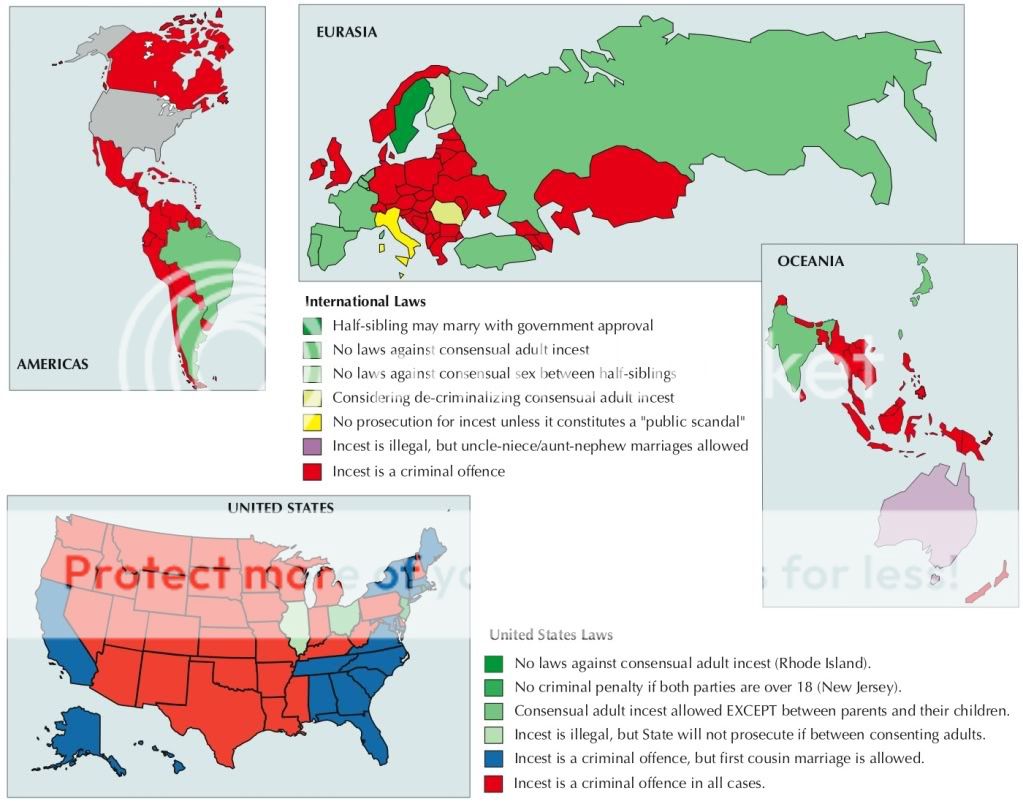
Incest is something that some people are talking more openly about enjoying…Clearly incest is coming out of the closet, so much so that Swiss legislators are calling for the decriminalization of consensual incest and such relationships are already legal in the Netherlands, Spain, Turkey, Israel and China.

But here’s where the limits of the liberal subject are felt. Because although consent is always problematic (do we really consent to work or are we obliged to do so?), it is even more problematic in conditions of extreme power imbalances.

Consent is always problematic? Wow, I wonder if this woman is married. Even if she is, is really married by choice? Did she really consent to be married, or was she powerless to say no because of the shiny diamond offered for her finger, or the power imbalance between her and her spouse? If consent is always problematic and that is reason to use the force of law to prevent or punish certain relationships, how can any contract stand up on a court of law? If consent is always problematic, then all sex, to one degree or another, is rape, right?

But let’s just say that the power balance between a father and daughter is not skewed—let’s just say the daughter is the one who is fabulously wealthy and famous and powerful and the father is a nobody and they have a consensual affair. Does that then make it OK?

Whether she thinks it is OK or not, it shouldn’t be illegal and they shouldn’t be denied the freedom to marry.

I’m going to say no: not just because it makes me ill to think about or because I think the community should regulate the morality of adults, but because I believe such relationships are like second-hand smoke. They threaten the health of all of us by infecting familial relations with the possibility of sexual relations.

Ah, I see. If her friend’s father his enjoying sex with her friend, then she’s going to feel pressured to have sex with her father, is that it? Really? Has she engaged in a same-sex relationship because anti-gay laws have been overturned and there are happy lesbian relationships and lesbians out of the closet? Or has she engaged in a heterosexual relationship only because it is legal? People are attracted to others for their own reasons. People consent to sex with others for their own reasons. That something isn’t a crime doesn’t mean you must do it.

If incest comes out of the closet and is accepted as just an alternative lifestyle between consenting adults, then all parent/child relationships are eroticized, at least potentially, since your father may just be your next lover.

Then we can’t let heterosexual men and women work together, and of course all of our relationships with friends of the same-sex have been eroticized because of LGBT rights. All relationsips that straights have with non-related people of the opposite sex are eroticized, right? Especially between different generations?

These objections can be reduced to “I don’t like it. I wouldn’t do it. So nobody else could possibly truly want to do it. So they shouldn’t be allowed.” Don’t want a consanguineous sexual relationship? Don’t have one. There are some places where they are legal, and family and society has not ended in those places.

Thursday, December 23, 2010

Hate Adds Pain to Genetic Sexual Attration and GSA Relationships

Genetic Sexual Attraction (GSA) is a condition that may be experienced when close genetic relatives who have been separated for significant amounts of time, often since birth or before puberty, are reunited. It describes an intense physical or emotional attraction, and may include sexual attraction or be expressed through sex. The attraction may or may not be mutual. Even if mutual, not all GSA results in sexual contact. (Some people prefer the term "Genetic Attraction.")

Reading accounts or watching documentaries about those struggling with GSA feelings or related actions can be heartbreaking. There are many reasons as to why.

First of all, there are all of the problems that come with any attraction or any relationship. One person is attracted to someone else and that attraction is not mutual, or is mutual only for period of time. Relationships involve at least two different people who are trying to get along with each other and to deal with those outside the relationship as well. This can all be increased when the individuals are biologically related.

This new attraction and resulting relationship can bring change, disruption, and uncertaintly to someone’s life, which is again something that may happen in general relationships as well, but can be more of an issue with biological relatives and the strong pull of GSA. This is especially a problem when someone has made a life and perhaps has existing vows with someone else. For example, a married, monogamous woman who gets in contact with a biological half-brother and finds herself strongly attracted to him and wanting to spend time with him, with or without sex. The time and attention taken from her marriage may be enough of a problem, but add sexual cheating to the mix, and it is even worse. She may love and value her husband, but feels this intense connection or draw to her half-brother that must be suppressed if she wants to have a chance to save her marriage. In that case, either choice is painful. Or what if she doesn’t want to save her marriage? What if it was dying before the GSA issue surfaced? Divorce is usually a painful experience anyway.

Some people experiencing GSA are disturbed by their feelings (or the feelings of their relative) because they feel a need to have that person in their life as a sibling, a parent, or a child, and they see sexual attraction or sex as incompatible with that role. They may feel like they finally had something they were missing for so long, only to have it taken away by unexpected or unwanted feelings and resulting tensions. Just the unfamiliar nature of these feelings may be bothersome.

In addition to all of the usual problems someone with an unrequited attraction or a mutual attraction between people can bring, one that is different with GSA is, of course, the legal, familial, social, and religious prohibitions imposed against sex with and marriage to close relatives. Incest between consenting adults is still criminalized in many places, including most US states, and bigotry against people in such relationships or experiencing such attraction continues to be perpetuated, sometimes in the most hateful and harmful ways.

This is sometimes compounded by a lack of solidarity. Even if there is a GSA relationship that didn’t break up any existing families, marriages, or relationships, and the individuals are happy together and able to share their lives in a functional way despite legal and social challenges, they may be rebuffed or judged when they reach out for understanding and support from others. Other people experiencing GSA who have decided not to have sexual relationship or have ended a sexual relationship or want to end their sexual relationship may disapprove of those who want to engage in or continue their sexual relationship. Or, if the GSA relationship is intergenerational, interracial [biracial with non-biracial], same-sex, or polyamorous, other people experiencing GSA may express disapproval based on one of those factors (in addition to all of the other people who disapprove based on those factors). Finally, those who have recently struggled or are still struggling for their own freedom to marry or just the basic freedom of association, such as LGBT people or poly people, may express contempt for consanguineous sex and love, including in cases where GSA is factor, or may be unsupportive of those in GSA relationships gaining the freedom to marry. Thus, instead of finding comfort from those who have also been targeted by those who want to control the sexuality of other adults, people experiencing GSA may find some more vitriol or at least a cold shoulder.

All of these things can bring pain and hardship to GSA relationships. Laws and public attitudes can be changed. There is some help for those struggling to deal with their feelings or the feelings of someone else or just to be themselves, but that help would be greatly aided by a change in the laws and public attitudes. That is one reason I call for solidarity. Someone who is struggling with GSA does not need the added burden of laws and finger-wavers that treat them as second-class citizens or with hate and impede their ability to make decisions in the best interest of themselves and their loved ones.

[Edited for typing errors and clarity.]

More Musings Prompted by David Epstein Case

Doug Mataconis takes a look at the legal issues raised by the David Epstein case, especially in light of Lawrence vs. Texas.

What it does mean, however, is that just because we don’t like something doesn’t mean it should be illegal, and that I cannot think of any good reason why Professor David Epstein should go to jail.

Thank you.

A psychoanalyst writes

There is almost no way to construct a rational, legally based morality that forbids incest between adults. Most of us have a visceral reaction of disgust when we think about incest because the taboos are so deeply ingrained but the incest taboo can not be supported by rational argument alone.

But the writer tries to come up with a reason that consanguineous sex is wrong for everyone…

In parent-child incest the difference between generations is denied and the significance of the primal ties between parent and child are denied.

The difference between generations is denied? No more so that any other intergenerational sex between adults. Those relationships are not illegal and are widely accepted, and so this can’t be a reason to have laws against consanguineous sex.

Parents and adult children are not legally obligated to have any ties. Ever hear of estrangement? Disinheritance? Also, I don’t think most people in these relationships deny their “primal ties.” Most are very aware of such ties.

Objections like these don’t even deal with the fact that laws are written in such a way that siblings, uncles/aunts and nephews/nieces can also be prosecuted for consensual sex.

What exactly is the offending behavior? What if a woman who was adopted as a newborn finds her birth father and pursues a relationship with him? It is okay for them to kiss each other on the cheek? The lips? It is okay for one to massage the other and touch every part of the other’s body except the genitals? Is it okay for them to live together and take care of each other? What exactly is wrong and should be illegal, and why? Those who want to deny others their rights to love, sex, and marriage don’t seem to give details, but they should have to justify and clarify why, exactly, they want to prevent other people from doing what they want to do with each other. They often cite “inbreeding,” but that is only possible with heterosexual intercourse and carrying a fetus to term. What about consanguineous same-sex relationships? Birth control? All of the other kinds of sex that aren’t intercourse? Are those wrong and justly outlawed just because the lovers are related?

Still Waiting For A Good Reason to Deny Marriage Equality

This guy tries to explain why only some adults should have the freedom to marry the person they love.

Essentially, I believe that whatever involves just consenting adults, and does not do violence to others or society as a whole, should be tolerated. And, when it involves the notion of legal equality, it should be accepted.

Sounds great.

Gay marriage: Sure. Fine. Whatever. "I think it's gross" is NOT sufficient legal justification for banning it.

Thanks for supporting this freedom to marry.

Incest: No, no, a thousand times no.

Why not? He struggles to justify his opposition to this freedom to marry.

In some cases, it involves minors -- so there goes the "consenting adults."

By starting out with this, he’s trying to equate fun, romance, and love between consenting adults with child abuse. It’s like making a case against adults working for a living because of child-slave labor. I, like most people who want marriage equality, condemn child abuse.

In others, it raises the likelihood of inbreeding -- so there goes the "harm to others."

We’ve dealt with this one so many times before. There is no law against people having children despite and increased risk that the child will inherit a disease or birth defect, so unless you want to deny reproductive rights and force everyone to take genetic tests and bar carriers and the congenitally disabled and women over 35 from having children, then equal protection prevents this from being a justification to bar this freedom of association and freedom to marry. Still, most children born to consanguineous parents are fine. Furthermore, there are people marry who have no intention of reproducing, and most sex does not result in a live birth, nor is it intended to. So give this one a rest.

In some, involving parents, squicky issues of power and authority and inequality are raised.

This objection also fails. Next?

But even in those cases where those pitfalls are avoided, the introduction of the sexual dynamic entirely within the family structure causes violence to society as a whole.

What does this mean, and where is the proof? One might as well say that it kills ancient redwood trees. Spell out the harm. The sexual dynamic often brings people closes together. If you’ve found otherwise, maybe you’re doing it wrong.

Bigamy: Too many legal nightmares.

That’s what the bigots said about same-sex marriage and the Americans With Disabilities Act and just about any civil rights laws. Of course it is easier for those who already have what they want to keep things as they are. But what about all of the people who are denied their rights?

Let's take the case of Adam, Eve, and Eden. Adam marries Eve, and then the two marry Eden. Then Adam wants out. What does that mean to the legal relationship between Eve and Eden? Are they still married, even if they don't want to be? Are they divorced from each other, even if they don't want to be?

Use some thinking. It is very simple. If Adam leaves, Eve and Eden have the option of either continuing in a reformed marriage or entirely dissolving the marriage. It’s called freedom of association. When one person leaves a polygamous marriage, the others can too. Or, they can stay. It is their choice, not anyone else's concern.

And what about children?

What about children from one night stands, donated sperm, surrogate mothers, affairs, brief flings, or supposedly monogamous marriage that's ending? What about children born to a woman whose husband wasn’t the man who impregnated her? All of these situations are entirely legal. A court decides custody disputes that aren’t resolved amicably.

Marriage is a straight line (pardon the expression), defined by two points.

In his limited imagination. Others are living in marriages that are different.

It can be made and broken relatively simply (geometrically speaking). Introducing more points, making it into triangles, squares (with corners also connected), and whatnot just gets messy. No just say no to bigamy.

Got that? You can’t have your freedom to marry because someone else finds it “messy.” I mean really, why does one person care if someone else’s relationship is more complicated than he would like for himself? Don't want a poly marriage? Don't have one.

It’s past time to stop this. Just let people marry the person(s) they want to marry. Stop persecuting and prosecuting people for the sex they have with other consenting adults.

The Kids Are Alright

The Las Vegas Sun had a column from high school student Jordan Orris, reporting on the 54th annual Sun Youth Forum. It was held on November 23 with about 1,000 students from high schools throughout Southern Nevada participating.

She says…

With regard to the role of marriage in contemporary America, two questions were posed: (1) Should polygamy be made legal? (2) Should gay couples be allowed to adopt children?

It is good that it wasn’t questioned if same-sex marriage should be legal. The students appear to assume it should be and will be legal nationwide.

We examined the benefits of marriage under the status quo, including emotional, spiritual, physical, cultural and financial incentives.

Interestingly, there were quite a few yeas for polygamy, whose arguments included that polygamy is an institution of Muslim society and should be legalized for religious rights purposes, and the catch-22 of prosecution for cheating in a relationship being no different from prosecution for marrying many.

Actually, cheating has been almost entirely decriminalized. Most, if not all, of the few cases in which cheating makes it to court and is relevant to a case is in civil court. Marrying more than one person when all involved consent is a far different thing than cheating, even if the marriage isn’t legally recognized. And such marriages should be legally recognized, not only for religious freedom but as a basic human right. It does not make sense that in some places in this country, someone can get into legal trouble for ceremonially marrying more than one person and caring for that person as a spouse, but has no risk of legal trouble for cheating with a series of affairs or one night stands. Polygamy should not be a crime. Why discourage anyone from loving and caring for another consenting adult?

Those in disagreement argued the legal entanglements caused by situations of divorce, child custody and child support.

I don’t see how it would be much different than with supposedly monogamous marriages. You know, requiring accommodations for the disabled meant far many more changes than it would take to accommodate this freedom to marry, and yet that was voted into law twenty years ago.

The dissenters also argued that polygamy was not relevant in America.

Of course it is relevant. There are American citizens who want this freedom to marry.

Others simply stated that the government should not intrude on the lives of people or their marriages.

Support full marriage equality and let the people decide for themselves. The younger generations are supportive, so it is only a matter of time before hate no longer has enough power to deny marriage equality.

Wednesday, December 22, 2010

Merry Christmas and Happy New Year

No matter what meaning, if any, someone personally holds in Christmas, it is usually a time to get together with friends and family.

It can be a painful time for those who have been rejected by their family because of their sexual orientation or choice in patner(s). LGBT people, poly people, and those in consanguineous, intergenerational, or interracial relationships may be reminded this time of year that even their own family hates them.

Some people make the best of this and get together with others who do not condemn them for being themselves, trying to ignore the hurt inflicted by some of their own family.

I have words for anyone who has driven away or banned someone in their family because of that other family member’s orientation or partner(s): Shame on you. You don’t have to like your family member’s sexuality or how they live. But you should reach out to them and support them instead of driving them away. Every person in your family does things you don’t like. Why single out a family member for punishment because of who they love? If your family member has a partner whose family is more accepting, guess who is going to win? Guess who is going to get to play with the grandkids/nieces/nephews? Not you.

If you can’t go “home” for Christmas, and you are feeling down and you haven’t managed to make plans with friends, consider doing so. Chances are, you know some other people who either can’t go home or would rather spend Christmas with you.

Things are looking up for the New Year. “Don’t Ask, Don’t Tell” is going to be the kind of history we look back on like segregation, thankful that it was done away with. The same-sex freedom to marry will likely advance in the US federal courts. The polygamous freedom to marry may advance in the Canadian courts.

So let’s look forward to the New Year and keep moving towards Full Marriage Equality!

Others May Consent to Something You Wouldn't

“Anonymous” left a comment on the post "Bigotry Expressed.” My response is below.

Thank you, Anonymous, for your thoughtful consideration and for comment.

I do not think she makes a good argument, because she expresses blanket certainty about diverse things about which she could not possibly be certain. There are adult children who are emphatic that they freely consent to have sex with a parent, some of whom claim to be the initiator, and others who would like to, but haven’t. It is their experienced word against her inexperienced word. Has she interviewed everyone involved and performed careful psychological analysis of each case?

If she had said that some apparently consensual cases could be the result of selfish grooming on the part of a parent, and explained that dynamic, then she would have a good argument.

“It seems pretty reasonable to presume that if a parent is having sex with their child, even an adult child, that the parent groomed the child into the sexual relationship.”

That may be reasonable to presume in some cases, but is a presumption that may or may not turn out to be true. Let’s assume the parent was a primary custodial parent. Is it impossible that a child could grow up having a healthy relationship with that parent, and after getting out of the home for college, the military, or any other form of establishing themselves, that adult child realizes that they have a sexual attraction to their parent? I do not think that is impossible. In addition, consider when the parent did not have primary custody or any custody, as is the case in so many Genetic Sexual Attraction cases.

It used to be widely agreed that it was reasonable to presume that someone who was attracted to someone of the same sex, which was classified as a disorder, must have those feelings as a result of flawed parenting, or a molestation or grooming. The truth is, people have a wide variety of attractions. You probably have some friends who have been attracted to someone and you can’t for the life of you figure out why. Likewise, some people are not attracted to their own parent and do not understand why someone else would be attracted to her own parent.

“It follows then that the law should prohibit incest to make sure that parents aren't grooming their children into a sexual relationship.”

It does not follow. There are mechanisms in place that could be used, especially if enhanced, to protect minor children from deficient parenting. I do believe that the job of a parent is to raise their minor child to be independent adults who only depend on others as a result of consent, usually for mutual benefit, support, or emotional fulfillment. But it is possible for a parent to do that and have the child become an adult and freely consent to sex with that parent. I strongly condemn child abuse. I would consider grooming a minor child to be your sexual partner to be child abuse. The crime should be in the grooming, not in any consensual sex adults have. If you want to write a new law for that one because you don't think existing child abuse laws suffice, go ahead.

There are many reasons a person, including that adult child, will have sex. Some are better than others. The question is legality. I would not advise someone else to have sex for each of the following reasons, but I would not want most of them to be illegal…

1. To bring physical or emotional pleasure to someone else
2. To express love/affection for/bond with another person
3. As a form of recreation or celebration
4. Religious ritual/command (do not withhold yourself from your spouse, etc.)
5. As a form of exercise or therapy
6. To reproduce
7. To satisfy curiosity, a desire, an urge
8. To gain or keep someone else’s attention
9. For ego/conquest
10. To emotionally hurt or anger someone else
11. To gain advantage/information
12. For compensation/trade
13. To infect someone else with a sexually transmitted disease without their consent

That’s not an exhaustive list and and there is some overlap, but out of all of those, the only ones that should be criminal are 13 and perhaps 12. #12 is illegal in many places, especially if the compensation is in the form of cash, but it is not currently the focus of this blog to argue about prostitution laws. An adult daughter (or son) may consent to or pursue sex with a parent primarily for the second reason, and that isn’t wrong if it doesn’t break existing vows to others and shouldn’t be illegal. I would say doing it for #10 would be wrong, but shouldn’t be illegal.

“But, I would ask you if at least some incestuous relationships are wrong?”

Any incestuous relationship involving nonconsent (which includes “consenting” minor children being used by adults) is wrong and should be illegal. Other relationships, including adult incestuous ones, may or may not be wrong. Some people consider a 20-something man and a 40-something woman wrong, or a woman and two men, or someone of Asian ancestry with someone of European ancestry, or a Buddhist and a Christian, or two people who bicker constantly as relationships that are wrong. Should any of them be criminal? No. As long as they are consenting adults, it should not be criminal. Do some people make better decisions than others? Yes. People consent to do all sorts of things they later regret. Doesn’t mean it should be illegal. If you can make a case that a specific 20-something woman is mentally ill or deficient to the point of not being able to consent and that the other person should have been aware of this, then that should be criminal (and the 20-something should have a legal guardian). But that would apply to anyone having sex with her, not just a close relative.

Something else that comes to mind is S&M. If you handcuff a nonconsenting stranger or a child for any reason other than law enforcement or self-defense, you are doing something that should be criminally wrong. But is it wrong to handcuff your consenting lover? Of course not. “Handcuffing” and “incest” are descriptions of behaviors, but those behaviors can be right or wrong. They should only be illegal when there is a lack of consent.

Tuesday, December 21, 2010

Page Added

I've added a page for clarity on my condemnation of sexual assault, coercion, and child abuse, since those things often get unjustly lumped in with certain consensual relationships involving adults.

I have also updated the blog template to make it easier to share the information presented here.

As always, thanks for spreading the word and I welcome your comments and suggestions. If there is a link I should know about, please tell me. If you want to share your story, you can write to me or I can interview you through email.

Todd Pettigrew is an Ally

Writing about the David Epstein case, he debunks William Saletan’s arguments supporting laws against consanguineous sex.

In any case, as one committed to reason, I have to look beyond whatever ick factor there is and ask what the rational argument would be against incest. In short, if Professor Epstein and his daughter want to get it on, who are we to say no? Even if it’s distasteful, does that make it immoral? And should it really be a felony?

Of course it shouldn’t. They are consenting adults.

But even if reproduction were a factor, we generally do not insist that people have a moral obligation to find mates that are genetically optimum or even genetically desirable. For instance, parents with Huntington’s disease have a very high chance of passing the illness on to their children. Does that mean that a person with Huntington’s has a moral obligation to abstain from sex? Would a married couple be immoral if they chose to have kids knowing that the kids are at a high risk for the disease? Would we send such parents to jail?

It is interesting how cases like this one bring out the part-time eugenicists.

As for Professor Epstein, I don’t know him or his daughter or the course of events that led to their supposed sexual union. The whole affair is probably more complex than media reports indicate — how could it not be? But assuming that no one was forced or otherwise mistreated (which would constitute crimes in other ways), I can’t, at least for the moment, find a rational way to condemn them.

There is no reason, other than “tradition” and bigotry, that there should be a law against consenting adults having sex, or getting married. All of the “reasons” fall apart under scrutiny and precedents. Be on the right side of history and support the right of consenting adults to love, sex, and marriage.

Bigotry Expressed

Elie Mystal is upset at David Epstein’s lawyer Matthew Galluzzo.

Coercion is inherent in every case of parent/child incest. EVERY SINGLE ONE.

It is clear for the context that she is talking about adults. How can she make such an assertion? There’s no way she knows the dynamics of every single relationship. She is like the racist who says that every interracial relationship is about rebelling against parents, or the rare lesbian who says that all male-female sex is rape. It is insulting. It is telling that throughout her editorial, which is a lot of bluster but little substance, she writes about father-daughter relationships. Not a word about mother-son, mother-daughter, or father-son. I wonder why? Nor does she address other consanguineous relationships outlawed in some or most places, such a between siblings, cousins, uncle/aunts and nephews/nieces (especially those close in age).

Epstein’s daughter is as much of an accomplice as a rape victim who was wearing a low-cut blouse is an accomplice.

This kind of talk is demeaning to people who have been subjected to rape. What doe she know about Epstein’ daughter and her relationship with her father?

I don’t care if she’s 50 when the incest happens. At the end of the day, children do not have the capacity to choose to have sex with their parents, simply because the parent/child relationship ruins the capacity for consent.

Much repetition, no evidence.

You can’t have sex with your children. You also can’t have sex with anybody who is below the age of legal consent. Are these hard rules to follow?

That’s a nice try at guilt by association, trying to link consensual sex between adults to statutory rape or child rape.

By this reasoning, all parents of adult criminals should be tried for the crimes as well, especially if they gave any indication that they approved of the crimes. Depending on how supportive the parents were of the criminal acitivity, their adult children shouldn’t be prosecuted.

The truth is, some adults consent to have sex with relatives, including parents. You do not have to like that, but it should not be against the law.

Equal Protection Under the Law

David Epstein’s lawyer Matthew Galluzzo wrote to Yes But However and makes the legal case for striking down laws against consensual consanguineous sex, while still trying to hint at a personal disapproval of such sex.

Second, I am a criminal defense attorney and not a religious leader or political activist, and accordingly, my argument is a legal one, not a moral or political one. I have never argued that homosexuality is the moral equivalent of incest, nor would I. I have never argued that the two are somehow similar biologically, psychologically, or ethically…

The comparison between the two is purely a legal one, and the legal argument that I am making is not a novel one – in fact, no less a legal scholar than Justice Scalia has already made it. I suggest that you read his dissent in
Lawrence v. Texas, but I will summarize the case for you:

This is very, very important.

Perhaps you didn’t realize it, but up until 2003, homosexual sodomy was still illegal in Texas and a few other states. Mr. Lawrence was arrested in Texas after being caught in the act by police officers in his own home, and was convicted of a crime as a result! He challenged the constitutionality of the state ban on sodomy, and initially lost because the Supreme Court had previously upheld the constitutionality of a similar state-level ban on sodomy in Bowers v. Hardwick in 1986.

However, in 2003, the Supreme Court overturned its own recent decision in
Bowers v. Hardwick and declared that Mr. Lawrence had a constitutional right to engage in sodomy in the privacy of his own home, and that public opinion about the morality of such conduct was no longer a valid basis to deny him that liberty.

This same reasoning can be applied to poly and consanguineous sex.

In the dissenting opinion, Scalia countered that as a result of this logic, there is a very valid argument to be made that there is now a constitutional right to engage in acts of consensual adult incest. That is the argument that I am now making on behalf of my client, and i explained that to both ABC News and the Huffington Post.

I hope his argument works.

If your counter-argument is that incest ought to be illegal because it is always coercive (and thus, the ban on it is necessary to advance a compelling state interest), then I ask you the following questions:

1) Should it be illegal for a 33 year old sister and a 34 year old brother to have sex with each other? Is that relationship really coercive?

Very good question, because of course it shouldn’t be illegal. Also, for people who claim that all parent-adult child sex is coercive, I want to know at what point the coercion shifts to the child, given that some aging parents exhibit increasing dependence on their child?

2) Should all coercive sex result in an arrest? If so, the police would need to start arresting bosses for having sex with their secretaries, rich older men for having sex with younger less-wealthy people, and so on, and so on. Fortunately for them, there is nothing in the New York penal law that makes “coercive” sex illegal in the absence of force.

Go read the whole thing. John Romano indicates that he is his not on board with solidarity, but doesn’t refute Galluzzo’s points.

Monday, December 20, 2010

Blogger Ponders BC Poly Case, Becomes Ally

Intellectual Waste appears to be anything but with this consideration of the Canadian poly trial.

But what we have to realize here is, that when dealing with polygamy we are traditionally looking at one man with many wives. We just need to junk the law and permit many forms of marriage. one women and many men, many women and many men. The combinations can be limitless. It just has to be a matter of consenting adults permitting to be married together.

Thanks!

That is my conclusion, legal polygamy, with restrictions on it, and very careful updating of the rest of the civil laws in the Canadian books.

That would be the sensible thing to do.

Read the whole thing.

Poly Allies on Yahoo Answers

It's nice to see poly people and allies speaking up on Yahoo Answers. Alexa posed the question...

What do you think about polyamorous relationships?

I used to oppose poly relationships, considering them a sort of unfaithfulness with consent. Within the past year or so though, I've done a complete 180, and now see it as a beautiful bond of love shared between more than two people with none being wronged or neglected if all are aware and consenting.

For those who care, yes, I am in a polyamorous triad. My girlfriend and I share a common additional girlfriend. I've dated my original girlfriend for two years, and she has dated the other girlfriend for one year. I've been dating the other for 2 months, but we were friends prior.

People grow.

A few allies spoke up...

it's not for me. but if a group of people are consenting adults and are open and honest with each other about the arrangement and all find it mutually beneficial they can do what they like.

Thanks!

Stephanie is right love is love but i mean i just hope that if people are doing this that they respect your decision umm im not against i just hope all 3 of you are taking its serious and not fooling around but apparently not i hope you 3 have a long happy marriage and umm also i think that its consits of the people who really want a huge family and as long as you guys get along i dnt think theres a problem

Thanks!

What ever goes on between CONSENTING Adults is their own business, I actually admire that you have such a sweet deal.

Thanks! Yes, don't hate them because they're having a good life.

And from a poly person...

Been in a stable Poly "V" for over 10 years. Been "poly" for over 30 years (before people understood the term). So I think you can guess what I think of Poly. sure there are rocky time, just like any relationship, but my life would not have been as fulfilling or happy . While poly is certainly not for everyone and isn't common in our culture these days, it is nice to know that poly has made some gains in terms of cultural acceptance.

We're going to move towards full marriage equality if this keeps up!

Joseph Compton Gets to Be a Father to His Children

There's an update on the case of Joseph Compton, who wants to be a father to his children and is fighting prejudice against poly relationships. I wrote about this case before.

A judge has reversed a custody order barring a Juab County man from talking to his children about his religious belief in plural marriage and taking his children to the largely polygamous community he lives in.

“The court received no evidence that any of the petitioner’s children, adult or minor, have suffered real harm or will suffer substantiated potential harm as a result of his belief in the practice, even though the practice is criminal,” 4th District Judge James Brady wrote in a Wednesday decision.

The practice shouldn't be criminal in the first place.

“To restrict parent time based on illegal conduct may be appropriate, but the illegality [of polygamy] on its own is not sufficient to warrant restriction,” Brady wrote. His decision gives Kathleen Compton custody of their four minor children but allows their father unrestricted visitation.

The decision reverses an October 2009 temporary custody order issued by 4th District Judge Donald J. Eyre, who said exposure to polygamy would entail “unnecessary and harmful conflict” with the children’s monogamous upbringing.

Even the ex-wife can't cite any real potential for harm...

“I am not afraid he is going to hurt them physically. I’m afraid they’re going to join the group or marry someone in the group,” Kathleen Compton said. “As their mother I will do anything to protect them.”

She's the mother, but he's the father, and he cares about them, too. Otherwise he wouldn't be going through this trouble.

Plural Wife also covers this story.

Sunday, December 19, 2010

A Dream of Poly-Friendly Media

From Uninhibited Bliss...

My dream is that there will be movies, TV programs and/or cartoons that represent a healthy poly family, so that poly children around the world will see that they are not alone.

Let's make that happen!

How Do I Know if This Movie Depicts Polyamory?

From Hollywood.com comes this about new movie "How Do You Know"...

In Matty, one finds How Do You Know’s most compelling feature. As a successful professional athlete, he is polyamorous by nature — it’s the only life he’s known. But he’s no scheming womanizer a la Tiger Woods. An accidental — and exceedingly polite — narcissist, beautiful women flock to him, offering sex without strings, and he graciously welcomes their company. In Lisa, he’s found someone with whom he genuinely wants to settle down, but he can’t seem to figure out how to square it with is existing values system. Love, the monogamous variety, is a legitimately alien notion to him.

Hmm. I need more clarification. Doesn't sound like the character is practicing polyfidelity. Rather's he's simply dating around. Am I wrong?

Also, some people do move from polyamory to monogamy, just as some people move from monogamy or polyamory, but I'm wary of anything that smacks of the idea that anyone would only be polyamorous because he or she simply hasn't "settled down" or found the right partner with whom to be monogamous, or has no discipline.

I don't plan on seeing the movie any time soon. Maybe a polyblogger will and can clarify if the movie is depicting polyamory, and how it is treated?